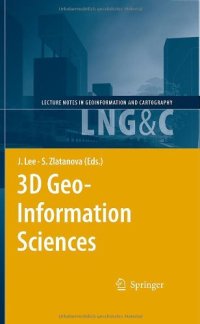
Ebook: 3D Geo-Information Sciences
- Genre: Computers // Information Systems
- Tags: Geographical Information Systems/Cartography, Computer Imaging Vision Pattern Recognition and Graphics
- Series: Lecture Notes in Geoinformation and Cartography
- Year: 2009
- Publisher: Springer-Verlag Berlin Heidelberg
- Edition: 1
- Language: English
- pdf
In recent years 3D geo-information has become an important research area due to the increased complexity of tasks in many geo-scientific applications, such as sustainable urban planning and development, civil engineering, risk and disaster management and environmental monitoring. Moreover, a paradigm of cross-application merging and integrating of 3D data is observed. The problems and challenges facing today’s 3D software, generally application-oriented, focus almost exclusively on 3D data transportability issues – the ability to use data originally developed in one modelling/visualisation system in other and vice versa. Tools for elaborated 3D analysis, simulation and prediction are either missing or, when available, dedicated to specific tasks. In order to respond to this increased demand, a new type of system has to be developed. A fully developed 3D geo-information system should be able to manage 3D geometry and topology, to integrate 3D geometry and thematic information, to analyze both spatial and topological relationships, and to present the data in a suitable form. In addition to the simple geometry types like point line and polygon, a large variety of parametric representations, freeform curves and surfaces or sweep shapes have to be supported. Approaches for seamless conversion between 3D raster and 3D vector representations should be available, they should allow analysis of a representation most suitable for a specific application.
The book contains papers that focus explicitly on the last achievements (methods, algorithms, models, systems) with respect to the Third Dimension. Motivated by the rapid developments in 3D, the organised workshop aims at attracting the best world-wide research in the following areas: 3D geo information requirements (based on analysis of applications), 3D data acquisition and processing (LiDAR, Photogrammetry), 3D object reconstruction, 3D spatial data models (vector, voxel, CSG, tetrahedrons, curved surfaces, etc.), 3D GIS and time, 3D in spatial databases, 3D topology and network, 3D visualization, Augmented and Virtual Reality, 3D spatial analysis and simulation, 3D Indoor/Outdoor Navigation, 3D and levels of detail (scale/resolution), 3D City Model and Building Model (outdoor and indoor integration), 3D applications (3D cadastre, 3D utilities, 3D city and urban planning modeling, etc. ), 3D standards.
The papers are organized in three parts as follows: Data acquisition and processing: advanced approaches for 3D data collection, processing and methods for real-time data acquisition - Data modelling and management: topological, geometrical and network models for representation and maintenance of 3D geo-information in geographical multi-scales - Data analysis and visualization: frameworks for representing 3D spatial relationships, 3D spatial analysis and algorithms for indoor/outdoor navigation, interpolation, etc. Advanced Virtual Reality and Augmented Reality visualization.